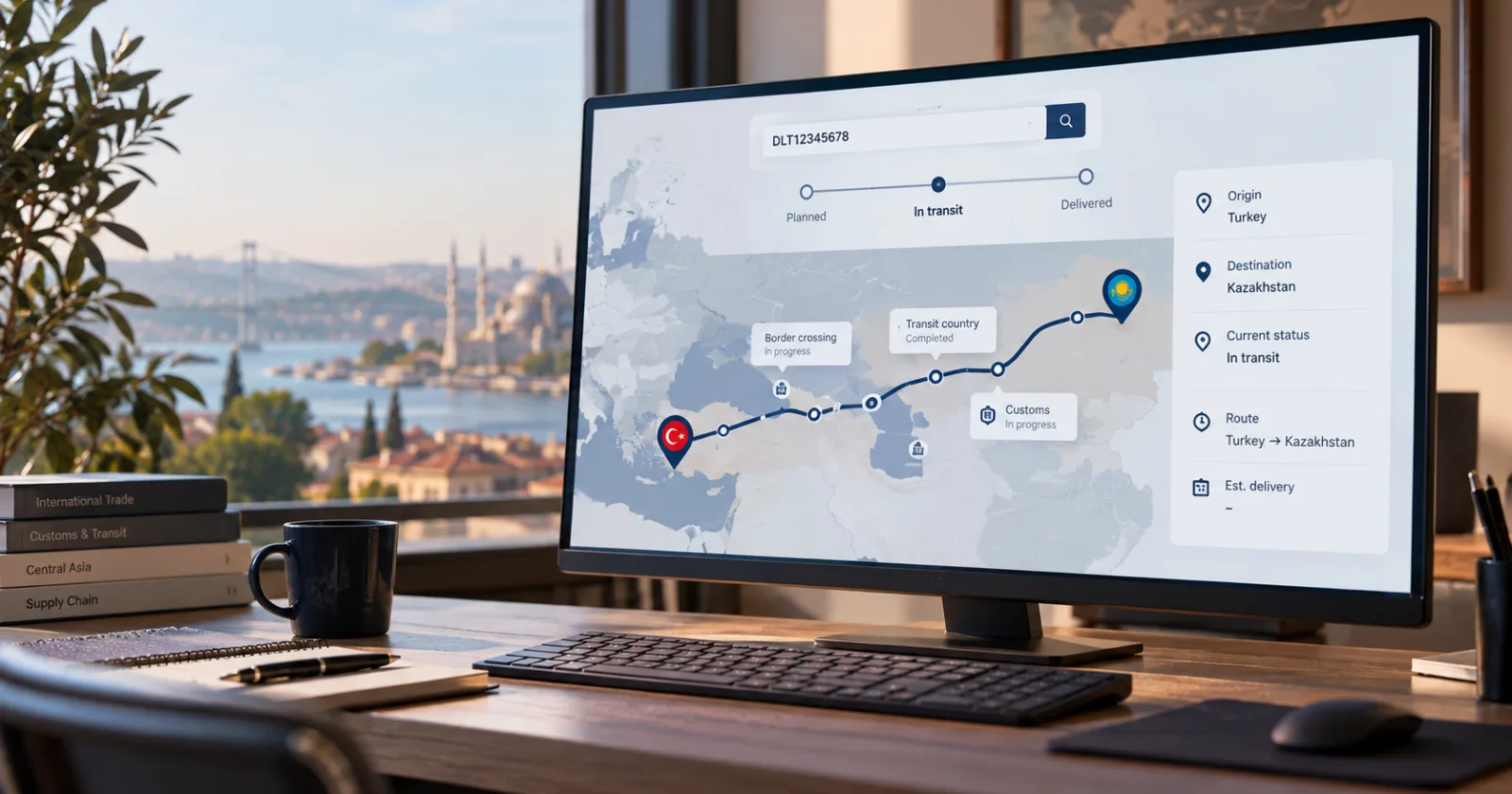


The three routes at a glance
The times below are Dealti's operational averages from Turkiye to Almaty. They vary with border queues, the ferry schedule and the weather.
| Route | Path | Time (to Almaty) | Key point |
|---|---|---|---|
| Russia transit | Turkiye - Georgia - Russia (Verkhny Lars) - Kazakhstan | 16-19 days | Shortest; the mountain pass can close in winter |
| Via Azerbaijan | Turkiye - Georgia - Azerbaijan - Russia (Caspian coast) - Kazakhstan | 19-22 days | Avoids the mountain pass; winter alternative |
| Caspian ferry | Turkiye - Georgia - Azerbaijan (Baku/Alat) - ferry - Kazakhstan (Aktau/Kuryk) | 25-29 days | Bypasses Russia entirely; the ferry wait drives the time |
1. Russia transit route (16-19 days)
Turkiye - Georgia (Sarp border crossing) - Russia (Verkhny Lars / Dariali pass) - Kazakhstan - Almaty. This is the shortest of the three.
The one critical point is Verkhny Lars, the only functioning road crossing between Georgia and Russia. It sits on a mountain pass and closes regularly in winter because of the weather; in some months the total closure adds up to several days. Summer and early autumn are the most predictable period. In peak season, truck queues can build on both sides of the crossing.
2. Route via Azerbaijan (19-22 days)
Turkiye - Georgia - Azerbaijan (Red Bridge border crossing) - the Caspian coast corridor through Russia - Kazakhstan - Almaty.
This route does not use the Verkhny Lars mountain pass; it runs along the flat corridor on the Caspian coast. It is therefore less exposed to winter disruption than the Russia route. In return it is a few hundred kilometres longer and the time rises to 19-22 days. It is used when Verkhny Lars is closed and when the delivery date needs to be secured.
3. Caspian ferry / Middle Corridor (25-29 days)
Turkiye - Georgia - Azerbaijan (Baku / Port of Alat) - Caspian Sea ferry - Kazakhstan (Aktau or Kuryk port) - Almaty. This route leaves Russia out entirely and is known as the Middle Corridor (Trans-Caspian International Transport Route, TITR). Total cargo volume on the corridor has grown quickly since 2022 (around 4.5 million tonnes across the corridor in 2024, most of it by rail).
The ferry crossing itself is short: the Kuryk - Baku route takes under 24 hours, the Baku - Aktau route around 20 hours. What drives the time is the ferry schedule. Sailings are usually every 3 to 5 days; a normal wait is 1 to 2 days, and it can reach a week when a port is congested. For loaded trucks the Kuryk port on the Kazakh side (built for roll-on roll-off traffic) is usually a better gateway than Aktau. The total time therefore rises to 25-29 days.
Border crossings
- Turkiye - Georgia: Sarp (on the Black Sea coast, the busiest crossing) and Turkgozu (Vale; lower traffic, reopened in June 2022)
- Georgia - Azerbaijan: Red Bridge (Tsiteli Khidi / Qirmizi Korpu), south-east of Tbilisi, the main freight crossing
- Georgia - Russia: Verkhny Lars (Dariali), the only functioning road crossing between the two countries
Transit documents: TIR and national transit
The CMR evidences the contract of carriage; the customs side of the border crossing is handled by the transit regime.
The TIR system is based on the TIR Convention of 1975 (United Nations Economic Commission for Europe). The customs duties and taxes on goods carried in a sealed vehicle are covered by an international guarantee chain managed by the IRU (International Road Transport Union). The vehicle is, as a rule, not opened along the route and no duties are paid at intermediate customs offices; the TIR Carnet acts as both the customs declaration and the proof of guarantee. 78 contracting parties take part in the system, including Turkiye, Georgia, Azerbaijan, Russia, Kazakhstan and China.
Where TIR is not used, the carriage proceeds under each country's own national transit regime. In that case the transit declaration and the guarantee are re-established in each country and the process requires more paperwork.
What drives the transit time
- Season: winter closures at Verkhny Lars (Russia route)
- Ferry schedule and port congestion: on the Caspian route this is where most of the delay comes from
- Border queues: public holidays and seasonal peaks
- Customs working hours: limited to daytime at some points
- Complete paperwork: errors in the CMR or invoice hold vehicles at the border
Choosing the route by cargo type
Full truckload (FTL): All three routes work. A full vehicle for a single sender moves through the border under one CMR and one customs operation, so it is usually faster than groupage. For time-critical shipments, the Russia route is the shortest option while Verkhny Lars is open. Our full truckload service.
Less than truckload (LTL): Runs on scheduled departures and consolidation hubs. The land routes (via Russia or Azerbaijan) carry no ferry wait, so the delivery date is more predictable for groupage. Our groupage service.
Heavy and out-of-gauge cargo: The route is planned in advance around transit permits and bridge restrictions; on the ferry route the vehicle dimensions are limited by roll-on roll-off capacity.
Refrigerated: For temperature-controlled cargo, the route time and border waiting times are built into the plan from the start.
Central Asia transport with Dealti Logistics
Dealti Logistics runs full and part load road transport between Turkiye and Kazakhstan and Kyrgyzstan; route selection, preparing the transit documents and customs clearance are part of the service. To find the right route and the current transit time for your cargo, use the quote form.
Sources
- United Nations Economic Commission for Europe (UNECE), TIR Convention (Geneva, 1975) and TIR Handbook.
- IRU (International Road Transport Union), the TIR system and the international guarantee chain.
- Trans-Caspian International Transport Route (Middle Corridor) public sources and industry reports; Caspian ferry and border-crossing information.
The transit times above (16-19 / 19-22 / 25-29 days) are Dealti's operational averages from Turkiye to Almaty and vary with border, ferry and weather conditions. Accessed: September 2026.